8 Lessons on Building a Tech Business Worth Acquiring
What makes a B2B technology company attractive to buyers? And what should founders be doing today if they want the option to exit in the next two or three years?
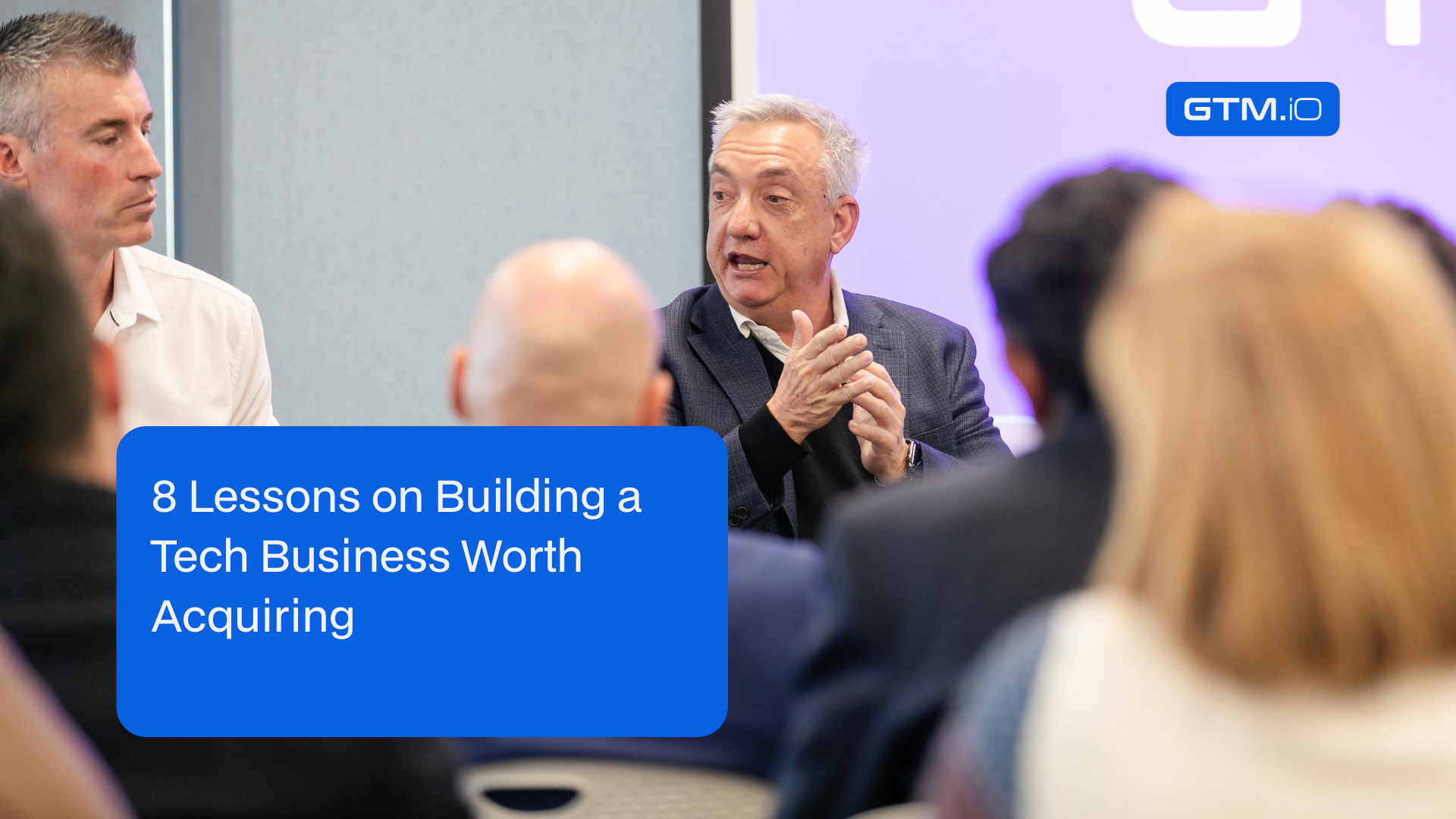
These were the questions at the heart of The Exit, a GTM.io event held in Sydney on 14 October 2026, bringing together founders, CEOs, investors and business leaders for a candid conversation about building, selling and transitioning technology businesses.
Hosted by Sidney Minassian, Founder & CEO of GTM.io, the panel featured two leaders with experience across three Australian technology company acquisitions:
- James Kahn - Founder of Idea 11, an IT services business acquired by private equity firm PieLAB.
- Hugh Amoyal - Former Chairman of Bang the Table, acquired by Granicus, and former CEO of Bueno Analytics, acquired by Copeland.
Together, they brought perspectives spanning technology products and services, private equity and strategic acquisitions, and the realities of life before, during and after an exit.
What followed was far more than a traditional panel discussion.
The audience included founders who had already exited, founders considering an exit, CEOs scaling their companies, advisors and operators. Their questions, challenges and contributions transformed the evening into a lively exchange of real-world experience.
Here are eight of the most valuable lessons.
1. Build a great business first. An exit is the outcome.
Before worrying about valuations, multiples or finding buyers, both panelists emphasised the importance of building a fundamentally strong business.
That means having customers who value what you do, a clear market position, sustainable economics, strong leadership and the operational capability to deliver consistently.
For James, building Idea 11 involved deliberately specialising rather than trying to be another generalist IT services provider.
The business developed a focused market position, strong operating processes and a recurring revenue model representing approximately 70% of its revenue at the time of sale.
For Hugh, the same principle applied to software companies.
Bang the Table and Bueno Analytics had products that delivered genuine customer value and could be commercially valuable to larger organisations.
The lesson: A company becomes attractive to acquirers because it has built something valuable, not simply because its founders decide they want to sell.
2. Reduce founder dependency - even when it hurts in the short term.
One of James's strongest insights was about the importance of building a business that doesn't depend on its founder.
As a founder, James was often the best salesperson in the company.
He had the relationships, experience and credibility to help close important deals.
But he deliberately stepped away from direct selling and day-to-day operations.
Sometimes that meant accepting a lower probability of winning a particular deal.
Why?
Because every customer relationship that depended on James personally made the business harder to transfer to a new owner.
Instead, Idea 11 invested in its sales team, systems, processes and customer management capabilities.
By the time of its acquisition, the business had grown to approximately 70 people and could operate without James personally driving every commercial activity.
The lesson: Founder dependency can be a major constraint on enterprise value.
For B2B technology founders, transitioning from founder-led sales and operations to a repeatable go-to-market system is not just about scaling revenue. It's about building a business that can thrive beyond the founder.
3. Great technology isn't enough. Buyers value commercial outcomes.
Hugh shared an example from Bueno Analytics that highlighted the difference between building sophisticated technology and building a commercially valuable business.
Bueno developed an analytics platform that helped organisations optimise energy consumption and building performance.
Its technical and domain expertise was significant.
But the company initially struggled to translate those capabilities into a compelling commercial story.
Hugh described how an important customer relationship with Woolworths helped reveal the gap.
The customer wasn't simply looking for technical insights. It wanted business solutions.
That realisation helped reshape Bueno's go-to-market strategy.
Instead of focusing primarily on product features, the company began communicating a broader customer journey, showing how organisations could progress from basic energy management to more sophisticated building optimisation.
This made the proposition more relevant to customers and differentiated the business from competitors.
When Copeland acquired Bueno, a major attraction was the opportunity to bring its technology and expertise to Copeland's much larger installed customer base.
Similarly, Bang the Table offered Granicus an opportunity to extend its product portfolio and sell additional capabilities to existing government customers.
The lesson: Buyers aren't necessarily paying for how clever your technology is.
They're paying for the commercial value it can create, including customer access, market expansion, revenue growth and competitive advantage.
4. Recurring revenue and operational maturity make a difference.
Recurring revenue was a significant part of Idea 11's value proposition.
Approximately 70% of its revenue was recurring, supported by managed services and other ongoing customer contracts.
That provided buyers with greater confidence in the stability and predictability of future revenue.
But recurring revenue alone wasn't enough.
James also described the importance of operational discipline.
Idea 11 had invested heavily in documented processes, systems and customer lifecycle management, from acquiring customers through to delivery, renewals and ongoing account management.
These investments became particularly valuable during due diligence.
James explained that buyers scrutinised everything from customer contract terms and retention to employment obligations and financial reporting.
Even relatively small issues could become negotiation points.
The company also worked to renew long-standing customer agreements into longer-term contracts, giving buyers greater confidence in future revenue.
The lesson: Predictable revenue, well-managed customer relationships and strong operational systems reduce uncertainty for buyers.
And reducing uncertainty can improve the attractiveness and value of a business.
5. The highest offer isn't always the best deal.
When Idea 11 went to market, it attracted multiple interested buyers and received approximately eight or nine term sheets during its initial sale process.
But the offers varied considerably.
Some involved more cash upfront. Others relied more heavily on earn-outs.
Some required longer founder commitments. Others had different expectations about ownership, management and the future direction of the business.
James revealed that he ultimately didn't accept the highest offer.
The structure of the deal, the buyer's intentions and the relationship with the people acquiring the company all mattered.
His transaction journey also included an unexpected setback.
An initial deal became delayed during the COVID period because of Foreign Investment Review Board approval requirements.
That deal eventually fell through, forcing Idea 11 to return to market and complete a second due diligence process before successfully selling to PieLAB.
Both James and Hugh strongly recommended engaging experienced M&A advisors.
But they also cautioned founders against becoming disconnected from the commercial conversations.
At critical points, direct discussions between the buyer and seller can be essential to keeping a transaction moving.
The lesson: An exit is more than a valuation.
Founders need to consider the deal structure, earn-outs, ongoing responsibilities, buyer alignment and what happens to the company and its people after completion.
6. The acquisition is only the beginning of another journey.
One of the most revealing parts of the conversation explored what happens after the transaction.
James described completing the sale of Idea 11 and returning to work the next day.
The ownership had changed, but he still had a business to run.
There were new shareholders, directors, reporting requirements and expectations.
For Hugh, the post-acquisition experience at Bueno exposed a different challenge.
The acquiring company wanted Bueno to retain its entrepreneurial independence.
But integrating a smaller, agile software business into a much larger organisation introduced unexpected operational friction.
Legal approvals, customer contracts and recruitment processes became significantly slower.
Activities that could previously be completed quickly now had to navigate corporate governance and risk-management procedures.
These changes affected the speed at which the business could pursue opportunities.
The discussion highlighted an important consideration for founders contemplating an acquisition.
The lesson: Understand how your business will operate after the deal, not just what it will be worth on the day of completion.
Cultural fit matters, but so do legal processes, decision-making authority, operational independence and the ability to keep serving customers effectively.
7. AI is changing the conversation about defensibility and exit timing.
One of the liveliest discussions came from the audience.
With AI transforming how software is developed and delivered, founders challenged the panel on whether traditional SaaS businesses could become less valuable or even obsolete.
Should founders be thinking about exiting sooner?
Or could AI create opportunities to make their businesses more valuable?
There wasn't a unanimous answer.
Hugh suggested AI could accelerate adoption of building intelligence platforms by making technical insights easier for customers to understand and act upon.
Other participants highlighted the importance of proprietary data, domain expertise and the ability to combine AI with reliable software systems.
James reinforced the need for software companies to embrace AI in their development processes to remain competitive.
The conversation raised a bigger strategic question.
What makes your business defensible when technology itself becomes easier and cheaper to build?
Is it your proprietary data?
Your domain expertise?
Your customer relationships?
Your distribution channels?
Your ability to execute and innovate faster than competitors?
The lesson: AI doesn't eliminate the fundamentals of building a valuable business. But it is forcing founders to reassess where their competitive advantage really comes from.
8. Leadership alignment can be just as valuable as product innovation.
One of the most memorable moments of the evening came when Hugh was discussing his contribution to Bang the Table.
Hugh explained how his role involved bringing commercial experience, governance and strategic perspective to a business led by passionate founders.
Then Matthew Crozier, one of Bang the Table's co-founders, contributed from the audience.
He explained that one of Hugh's most important contributions was helping three founders, each with different perspectives on the future of the company, come together behind one strategy.
It was a powerful reminder that building a successful technology company is as much a leadership challenge as it is a commercial or technical one.
Founders can have a great product, a promising market and capable people, yet still struggle to execute because of competing priorities, unclear ownership or a lack of alignment.
The lesson: Enterprise value isn't created by technology alone.
It's also created by leadership teams that can agree on a direction, make decisions and execute together.
The bigger takeaway: Build a business that gives you choices.
Across three acquisitions and two very different perspectives, a common theme emerged.
The best time to build a business worth acquiring is long before you're ready to sell it.
James spent years reducing founder dependency, developing recurring revenue and building operational maturity.
Hugh helped technology businesses strengthen their commercial strategies, align leadership and translate technical capabilities into customer and strategic value.
These weren't simply exit preparation activities.
They were the foundations of better businesses.
And that's perhaps the most important takeaway for founders.
You don't need to be planning an exit to benefit from building a company that can operate beyond you.
A business with predictable revenue, strong customer relationships, clear differentiation, capable leadership and repeatable go-to-market execution creates options.
You can continue scaling.
You can raise capital.
You can acquire other businesses.
You can appoint new leadership.
Or you can sell when the right opportunity emerges.
The objective isn't necessarily to build a business you can sell. It's to build a business that gives you the freedom to choose.
More than a panel. A conversation among founders.
What made The Exit particularly special was the contribution from everyone in the room.
The questions went well beyond the prepared discussion.
Founders challenged the panelists on deal structures, due diligence, culture, AI, valuations, recurring revenue and the emotional realities of selling a company.
At times, the panelists were questioning each other.
At other times, experienced founders in the audience were adding their own perspectives, challenging assumptions and sharing what they'd learned.
There was humour, healthy debate and plenty of candid reflection.
It was exactly the kind of environment we want to create through GTM.io's in-person events.
A place where founders, CEOs and business leaders can have meaningful conversations, exchange experiences and build relationships with people facing similar challenges.
A special thank you to James Kahn and Hugh Amoyal for sharing their experiences so openly, to everyone who contributed to the discussion, and to AWS Startups for supporting the event.
Join us at a future GTM.io event
At GTM.io, we work with founder-led B2B technology companies to build the commercial leadership, operating rhythm and execution capabilities needed for sustainable growth.
We also believe some of the most valuable learning happens when founders and leaders get together in person.